|
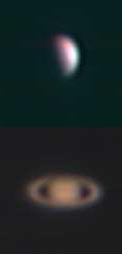
Venus and Saturn 4th September 2004 03:00 - 03:20 UT Venus was 200 frames out of 275 frames captured and stacked in K3CCDTools 1 Saturn was 600 frames out of 800 frames captured and stacked in K3CCDTools 1 Additional processing in Photoshop My F5 reflector is really not cut out for planetary imaging. I would like to get a better quality and/or higher power barlow at some point, plus the QCVC only gets images at 352x288 resolution so these were just for the sake of it really. By the time Mercury was above my garden fence, it was lost in the glare so I will have to see it another time. |
|
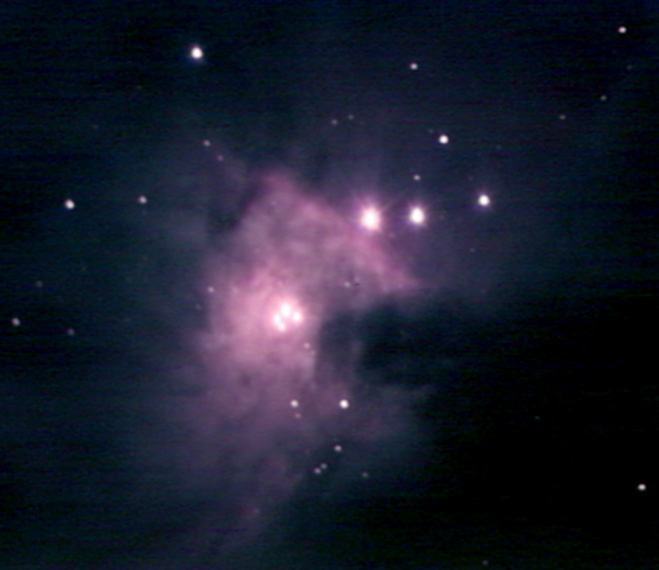
M42 core/Trapezium region 4th September 2004 04:00 - 04:25 UT 25x1 second, 30x3 seconds and 25x8 seconds captured in K3CCDTools 1 15 dark frames stacked for each of the 3 parts. Processing in Photoshop, via FITS Liberator While I was imaging the moon, I looked at my planetarium software (Hallo Northern Sky) and noticed that both Venus, Saturn and Mercury would be up in a couple of hours so I started looking for something to do. I saw a bright red star in the north and discovered it was Betelgeuse. I didn't realise that Orion would be back within the dark hours for a while yet and I just caught M42 visually as it went behind a house. So I waited for about an hour and started taking pictures of the core. After I had done these short exposures both the fan and the longer exposures on the webcam stopped working. 8 seconds was the longest I could take so this is just the very core. I used one of Jerry Lodriguss' tutorials here to blend the exposures together so that the trapezium stars are not overexposed and I am very pleased with the results and I am looking forward to a couple of months time when I can do a mosaic of the whole object. |

|
Giant Moon 4th September 2004 01:00 - 02:00 UT 43 avis of 20 frames (roughly 5x10 grid, missing out corners) captured in K3CCDTools 1 Using 2x barlow that came with the scope. No flatfield because I forgot I needed to. Processing in iMerge, then Photoshop, via FITS Liberator Resulting image is 3000x3236 pixels and file as bmp is 28.4Mb! This was an idea that I had last week, to get a picture hi-res enough that I could get it printed at a photo shop on A3 paper and hang it on the wall. I don't know if it will look that good as there is a lot of horizontal lines because of noise that the webcam introduces. I will try it and see anyway. I also got a shot of the moon later on with my digital camera (Olympus C5050) taken through a 25mm eyepiece that is on my webpage. click on the image for the full-res version (only 400kb) or click here for my digital camera version (169Kb) |

|
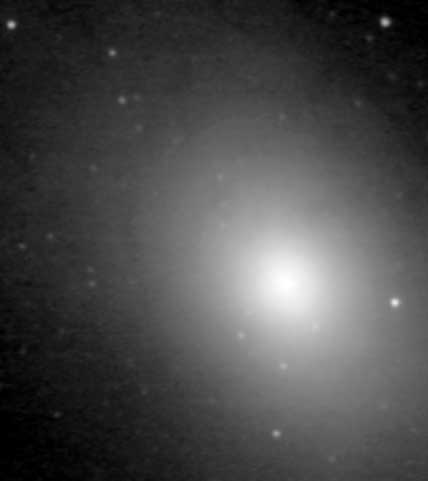
M31 4th September 2004 01:00 - 02:00 UT 35x30 seconds captured in K3CCDTools 1 25 dark frames stacked Processing in Photoshop, via FITS Liberator I thought I would try this again as my camera suddenly decided to let me use exposures greater than 15 seconds for a change. My last attempt at M31 (below) just caught a hint of a few dark structures outside the core. This one swamps them with light and reveals the next lot of dark thread-like structures out which is progress at least. |
|
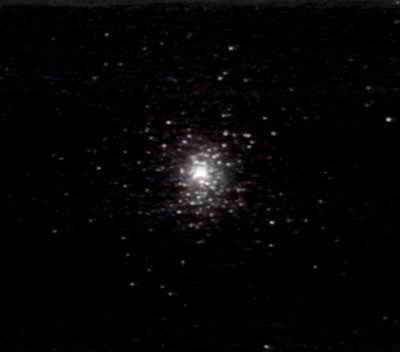
M15 2nd September 2004 20:30 - 21:10 UT 30x10 seconds and unsharp mask in K3CCDTools 1 15 dark frames stacked Extra Processing in Photoshop, via FITS Liberator Clouds started coming in just as I had got set up and found M15 so I had to keep it short. I think this was a bit out of focus but I didn't have time to go and find a bright enough star to give diffraction spikes and find this again. Again, something to come back to when time allows. |
|
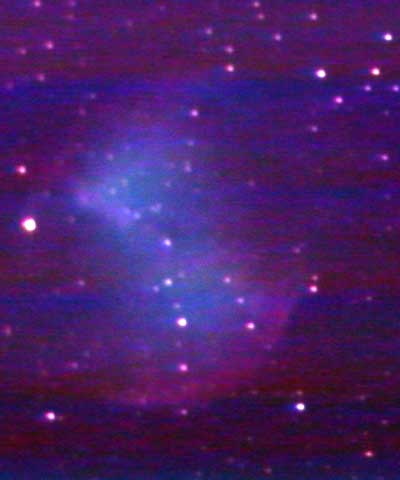
M27 - The Dumbbell Nebula 1st September 2004 21:40 - 22:40 UT 172x16 seconds, stacked (10 frames each) and unsharp mask in K3CCDTools 1 27 dark frames stacked Extra Processing in Photoshop, via FITS Liberator I have hit a limit with this one, 16 seconds just isn't enough without getting rid of the background noise for something this dim. I will be investigating air-cooling over the next day or two. It is interesting that the noise is in equal width horizontal strips, changing from red to blue then starting again. This makes me think it is electrical interference rather than plain thermal noise. The strips move between frames which is why the dark frames don't get rid of them. It's a shame because there is actually some detail in there. A very faint blue patch is all that was on the raw frames, sometimes it couldn't be seen at all. |

|
Moon 31st August 2004 01:20am UT 12 avis captured, stacked (10 frames each) and unsharp mask in K3CCDTools Mosiac put together in iMerge. Extra Processing in Photoshop, via FITS Liberator I had some better images to work with tonight so this moon is quite impressive. Click the image for the full size version (1200x1281, 290kb). I accidently left x2 mode on in K3CCDTools and noticed that the images actually survived quite well so after making the full version I reduced it in size to 1200x1281 and I think it looks quite good. |
|
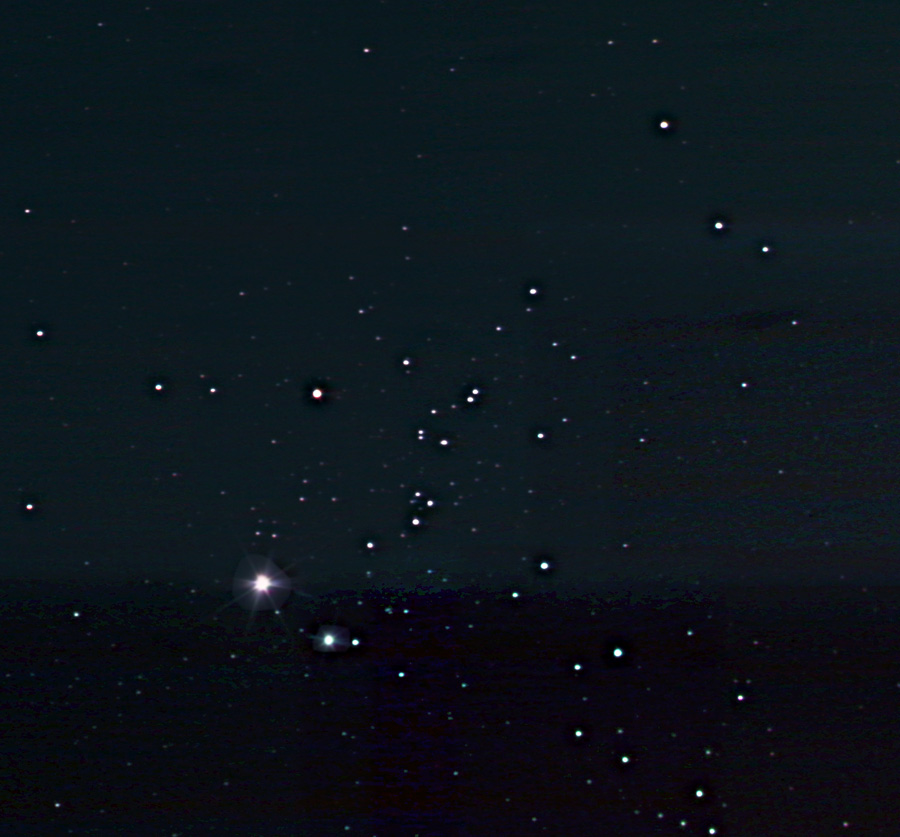
NGC457 - The Owl Cluster 31st August 2004 22:30 - 00:50am UT 9 avis captured (average 48x10 seconds), stacked and unsharp mask in K3CCDTools 50 dark frames Mosiac put together in iMerge. Extra Processing (curves) in Photoshop, via FITS Liberator I wanted to see if I could make a mosaic out of a open cluster that was too big for the QCVC field of view. This is quite time consuming, in the end it took almost 2.5 hours and involved capturing over 500 frames of 10 seconds each. Unfortunately I found out afterwards when I went to take the next mosaic of the moon that the secondary mirror was covered in dew. When I was processing this it turned out that the top row of 3 images of the mosaic are good and can stand quite a bit of maniulation, but the bottom 2 rows of 3 have lost most of the background detail and the images are very noisy so I had to be a bit brutal in processing so get many of the fainter stars to appear. I will attempt to redo it at some point, but not in the immediate future. |
|
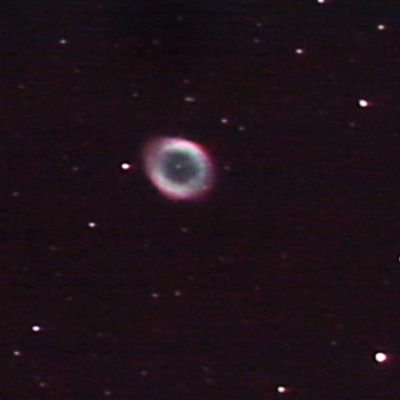
M57 Planetary nebula in Lyra 31st August 2004 20:50-21:30 UT 92x15 seconds, captured and stacked in K3CCDTools Extra Processing and tweaking in Photoshop, via FITS Liberator 39 dark frames stacked I had a late dinner last night so I decided to see if any colour at all could be pulled out of M57 with the QCVC. I set it capturing 15 second exposures (half of what I had tried previously due to the camera problems) with the QC drivers set to maximum saturation and reduced contrast and left it going for a while. I got colour all right, and a slightly better image than my previous effort so I am happy with that. It has picked up slightly fainter stars that were only visible by invering the previous version. |

|
Moon 30th August 2004 01:00am UT 12 avis captured, stacked and unsharp mask in K3CCDTools Mosiac put together in iMerge. Extra Processing (curves) in Photoshop, via FITS Liberator I went a bit to far with the unsharp mask so this image is a bit harsh, but not bad for my first mosaic. Click the image for the full sized version. Update. I reprocessed it with more subtle unsharp masking. Update 2. I reprocessed using a new technique and doubled the resolution. |
|
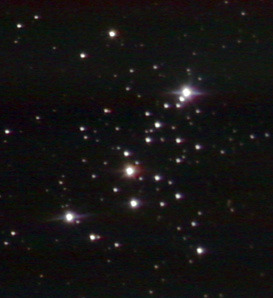
M103 Open Cluster in Cassiopeia 30th August 2004 23:50-0:20am UT 140x8 seconds, captured and stacked in K3CCDTools Extra Processing (curves) in Photoshop, via FITS Liberator 25 dark frames stacked I decided to try something other than very long exposure imaging because of both the problems I am having with anything over 18 seconds, and periodic error. This was one of the only open clusters that was within view that would fit into a single CCD frame. The central star is a red giant, so this is also the first time that the QCVC has given the correct colour to an image. The star at the top center is also slightly red, which is correct. |
|
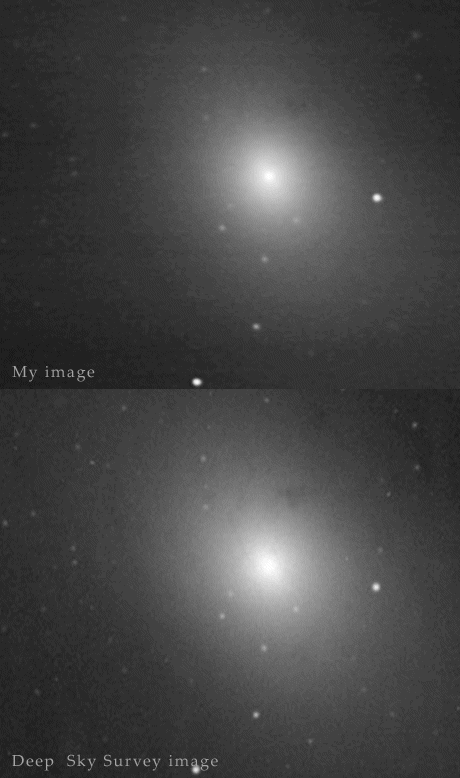
M31 Galaxy in Andromeda 29th August 2004 23:30-0:30am UT 31x18 seconds, captured and stacked in K3CCDTools 4 dark frames stacked My first attempt at M31 and I am fairly pleased. The webcam isn't working properly though, electrical interference is making exposures longer than 18 seconds impossible. I was still surprised though to find some faint detail in the image at the 11:30 and 12:30 o'clock positions. I look forward to trying a 30 second set of images when I can sort out what is causing the interference with the camera. Click on the image for a version blinking between this image and a Deep Sky Survey version of the same field. |
|
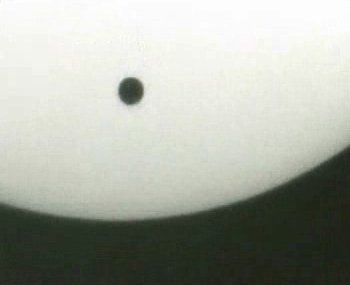
Venus Transit 2004 I missed capturing the first hour of the transit as a house was in the way of the sun, but this is the rest of it. Egress to come when I process it, I don't feel up to aligning 600 frames by hand right now. Click on the image for a DivX encoded .avi (450k) of the main transit. All frames hand aligned in K3CCDTools. Several .avis stiched together in VirtualDub. Quickcam VC, 1 frame every 30 seconds, other settings not recorded. |
|
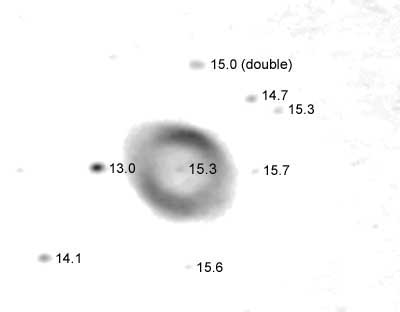
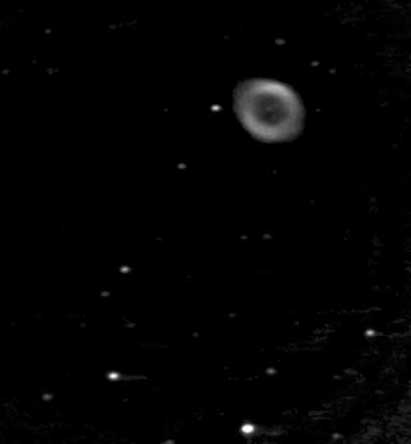
The same as the one below, but inverted and with magnitudes of the stars on. Some sites show different magnitudes for these stars, so I chose the one that seemed most credible, taken from USNO data here You can see that the stars are still a bit stretched horizontally due to tracking errors. |
|
M57 Planetary nebula in Lyra 22/05/2004 1:08-2:00am UT 29x30 seconds, stacked in K3CCDTools 14 dark frames stacked Second attempt and I'm much happier with it. Even the central star is visible now along with the other star that happens to be inside the ring itself. The noise is also much less noticeble with a few more frames. |
|
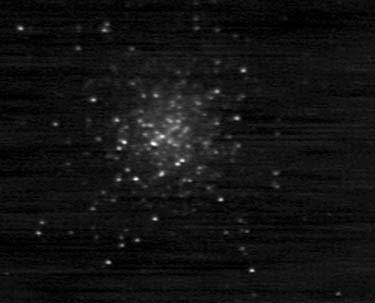
M13 A globular cluster in Hercules 25/04/2004 1:25-1:35am UT 13x15seconds, stacked in K3CCDTools 3 dark frames stacked My first real DSO with a webcam :) I am confident that with more frames the noise will be greatly reduced. Other people seem to be capturing 50-100 frames for DSO's so I will do the same next time and see what happens. |
|
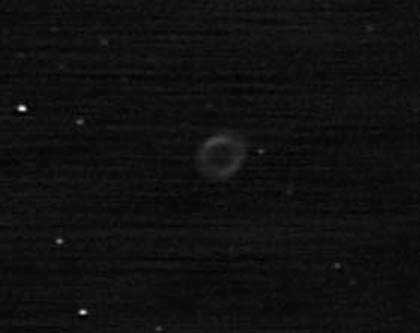
M57 A planetary nebula in Lyra 25/04/2004 2:04-2:20am UT 17x20 seconds, stacked in K3CCDTools 5 dark frames stacked |